Cox’s Bazar Panel Survey
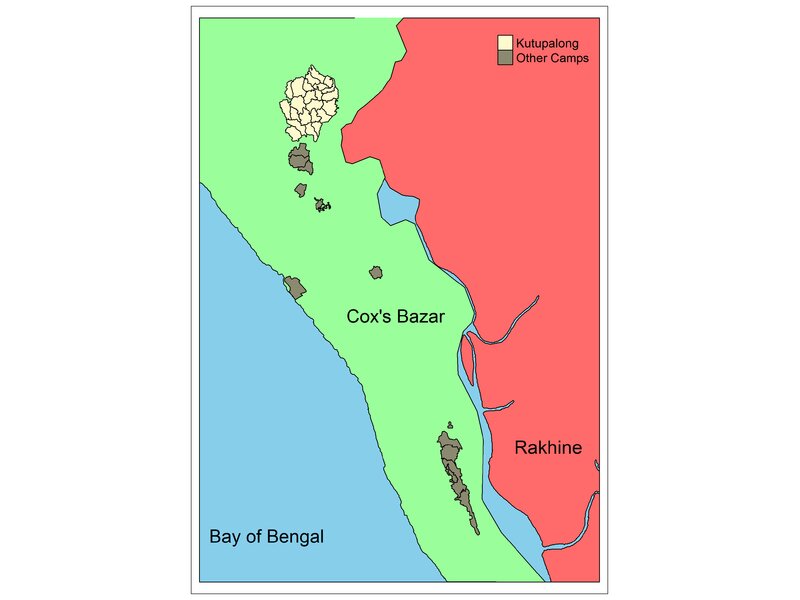 Rohingya camps in Cox’s Bazar. Map: Demandre, Davis, and Salemi (2024).
The Cox’s Bazar Panel Survey (CBPS) follows Rohingya refugee households and their Bangladeshi neighbors over time in Cox’s Bazar, the district of southeastern Bangladesh where close to one million Rohingya live in one of the largest refugee settlements in the world. It is one of the few sources of systematic, representative panel data on a major refugee population, and both rounds are public.
Representative data on displaced populations and the communities that host them are scarce, which leaves the core policy question largely unanswered: which programs should be prioritized to maintain or improve the well-being of both refugees and hosts? The CBPS was built to supply that evidence, to monitor conditions over time, and to provide sampling frames for future program evaluations.
Get the data
Both rounds are public on Harvard Dataverse. Please cite the round(s) you use.
Round 1 (2019). https://doi.org/10.7910/DVN/V614VB
Baird, S., Davis, C. A., Genoni, M., López-Peña, P., Mobarak, A. M., Palaniswamy, N., Seager, J., & Vishwanath, T. (2021). Cox’s Bazar Panel Survey. Harvard Dataverse, V2. https://doi.org/10.7910/DVN/V614VB
Round 2 (2023). https://doi.org/10.7910/DVN/KBVDFV
Davis, C. A., López-Peña, P., Mobarak, A. M., Seager, J., Baird, S., Etang Ndip, A., Genoni, M., Palaniswamy, N., & Vishwanath, T. (2025). Cox’s Bazar Panel Survey (CBPS) Round 2. Harvard Dataverse, V1. https://doi.org/10.7910/DVN/KBVDFV
The 2020–21 phone tracking surveys are available from the World Bank Microdata Library. The data are also catalogued by the UK Data Service (studies 8750 and 9529), the UNHCR Microdata Library, the International Household Survey Network, and Princeton University’s Data and Statistical Services.
Design
A census of 45,916 households, divided between camp and host communities, served as the sampling frame. From it, 5,020 households were drawn into the panel across three strata: households in the camps, host households within 15 km of a camp, and host households beyond 15 km. The camp sample covers all camps; the host sample covers six upazilas of Cox’s Bazar district (Chakaria, Cox’s Bazar Sadar, Pekua, Ramu, Teknaf, and Ukhia) and one in neighboring Bandarban.
Each round combines a household interview with one adult (roster, food security, consumption, assistance, assets, income, and child anthropometrics) and individual interviews with up to two randomly selected adults covering employment, migration history, crime and conflict, health, trauma (Harvard Trauma Questionnaire), and depressive symptoms (PHQ-9).
| Round | Fieldwork | Notes |
|---|---|---|
| Round 1 | April–July 2019 | Baseline, full in-person survey |
| Phone tracking | 2020–2021 | Three short welfare rounds during COVID-19, led by the World Bank |
| Round 2 | July 2023–January 2024 | Full in-person follow-up of the panel |
Research using the CBPS
By the survey team
- Davis, López-Peña, Mobarak, and Wen (2026). The Economic Drivers of State Violence against Civilians: Evidence from Myanmar. The Economic Journal.
- Davis, López-Peña, Mobarak, and Wen (2024). Refugees Are Hosted in Highly Vulnerable Communities. AEA Papers and Proceedings.
- Demandre, Davis, and Salemi (2024). Greenspace and Rohingya Refugee Mental Health in Bangladesh. Working paper.
- López-Peña, Davis, Mobarak, and Raihan (2020). Prevalence of COVID-19 Symptoms, Risk Factors, and Health Behaviors in Host and Refugee Communities in Cox’s Bazar. Bulletin of the World Health Organization, preprint.
By other researchers and institutions
- Etang Ndip, Rozo, Urbina, and Wieser. Refugees and Humanitarian Aid: The Rohingya Impact on Bangladesh’s Development. World Bank Policy Research Working Paper 10884 (2024); published in World Development.
- Ritsema and Armstrong-Hough (2023). Associations among Past Trauma, Post-Displacement Stressors, and Mental Health Outcomes in Rohingya Refugees in Bangladesh. Frontiers in Public Health.
- Rozo, Urbina, and Wieser. Welfare of Rohingya households relocated to Bhasan Char, using both rounds. Presented at the Fourth Research Conference on Forced Displacement, World Bank–UNHCR Joint Data Center, 2026.
- Carli, Endara, Segnana, and Uras. How refugees trade in-kind food aid. Presented at the Fourth Research Conference on Forced Displacement, 2026.
- World Bank and UNHCR (2025). Two Settlements, Two Diverging Paths: Jobs and Labor Market Outcomes for the Displaced Rohingya Population.
- World Bank (2021). Cox’s Bazar Panel Survey briefs on demographics, work and wages, living conditions, and the effects of COVID-19.
Using the CBPS in your work? I’d be glad to hear about it: cadavis@american.edu.
Team and support
Principal investigators: Sarah Baird, C. Austin Davis, Alvin Etang Ndip, Maria Genoni, Paula López-Peña, A. Mushfiq Mobarak, Nethra Palaniswamy, Jennifer Seager, and Tara Vishwanath.
Partners: the Yale MacMillan Center Program on Refugees, Forced Displacement, and Humanitarian Responses and the Yale Research Initiative on Innovation and Scale; Gender and Adolescence: Global Evidence (GAGE, ODI Global); and the World Bank. Data collection by Innovations for Poverty Action Bangladesh.
Funding: the Yale Program on Refugees, Forced Displacement, and Humanitarian Responses; UK International Development through Innovations for Poverty Action’s Peace and Recovery Program; GAGE, supported by UK aid; and the World Bank.